Coding 12 Hours/Day but Salary is Stuck? The 'Lazy' Colleague Gets Promoted Instead — Here's the Math
The hardest-working engineer isn't always the highest-paid. Data from Google, McKinsey, and DORA proves: those paid 3-5x more are often 'lazy' at coding but smart at leveraging systems. This is the framework shift from Maker to Multiplier.
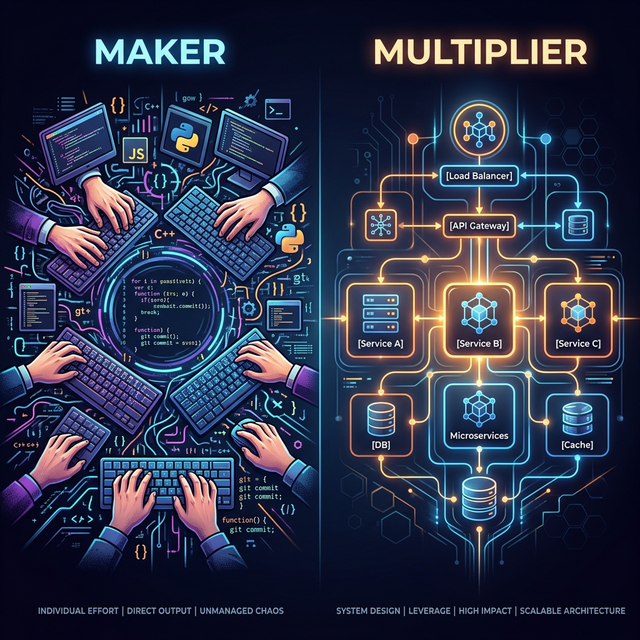
- 💰 The $1,000,000 Math Problem
- 🪞 Honest Confession: I Used to be a "Super Chicken"
- 📊 The Career Progression Framework
- 🔧 Level 1: The Linear Worker (n = 1)
- ⚡ Level 2: The Leveraged Lead (n = 5-10)
- 🌍 Level 3: The Exponential Strategist (n = 100+)
- 💵 Real World ROI: Show Me The Money
- Project Tepati ROI (Real Numbers)
- 🔄 The Multiplier Flywheel
- ⚔️ Super Chicken vs Multiplier: Lessons from Tepati
- 📉 The Hidden Cost of Being a Hero
- 📐 The 20% Rule: A Practical Framework
- ✅ Weekly Multiplier Checklist
- 🧪 Self-Assessment: What Level Are You?
- 🎯 Conclusion: From Tepati to a Multiplier Mindset
- 📚 References & Further Reading
Stop Coding
🛑 Read this first before you spend the weekend refactoring code that no one will ever read.
💰 The $1,000,000 Math Problem
In Silicon Valley, there's an open secret rarely discussed in any bootcamp:
"Don't be a 10x Engineer. Be a 10x Enabler." — Tanya Reilly, Staff Engineer at Squarespace
Let's brutally dissect the math.
Assume the average engineer salary at a Series B startup is $120k/year (source: Levels.fyi, 2024). You are a "Super Coder" working 200% harder than your peers.
- 🏋️ Your Impact (Maker): 240k value/year**.
- 😵 Hidden Cost: High burnout risk. According to research by Haystack Analytics (2023), developers working >50 hours/week have a 2.4x higher chance of resigning within 12 months.
Now, imagine your colleague — the "Multiplier". They aren't coding features. They spend their time building an internal developer platform that accelerates 50 other engineers by just 10%.
- 🚀 Their Impact (Multiplier): 50 × (600k value/year**.
- 😎 Bonus: They go home at 6 PM, don't burn out, and get promoted.
They provide 2.5x more value than you, who works overtime every night. This is why CTOs and Staff Engineers are paid highly. Not for typing code, but for multiplying organizational output.
🪞 Honest Confession: I Used to be a "Super Chicken"
Before we move on to theory, allow me to be honest.
I used to be a Super Chicken — and at the time, I felt great. In Project Tepati, I built the entire backend system for a microfinance application at one of Indonesia's largest Islamic banks, alone, in 30 days. Golang microservices, Kafka, AMQ, MongoDB, MQTT, sync engine — everything.
The result?
| Metric | Before | After | Change |
|---|---|---|---|
| 📈 Customers Served | 2.8 million | 4.1 million | +46% |
| 💰 Cost per acquisition | Baseline | -62% YoY | ↓ 62% |
| ⚡ Turnaround time | 7 days | < 24 hours | ↓ 85% |
| 📉 Data loss rate | 23% | 0% | ↓ 100% |
| 👩💼 CO productivity | 8 customers/day | 18 customers/day | +125% |
Those numbers are impressive. But there's a dark side that never made it into the presentation slides.
Eid Eve: A Personal Horror Story
🩸 Eid al-Fitr Eve. The MQTT broker overloaded. Millions of messages piled up. While everyone was gathering with family, I was cornered in the guest room — restarting the broker and clearing retained messages via terminal. No DevOps. No L1 Support. Just me. Building a system alone means you don't have the privilege to say "that's not my job description".
This is the reality of the Maker mentality at its peak: incredible output, but unsustainable and unscalable. I was a Single Point of Failure for a system serving millions of customers.
📊 The Career Progression Framework
From the Tepati experience, I learned that an engineer's career isn't measured by how much code you write, but by how large your radius of impact is. Here is the framework used by companies like Google, Meta, and Stripe:
🔧 Level 1: The Linear Worker (n = 1)
"I can fix this bug in 1 hour."
Focus: individual tasks. Impact is limited to your working hours. If you're sick, team productivity drops. This is a Single Point of Failure — exactly like my position in the early phases of Tepati.
| Metric | Value |
|---|---|
| 👤 Scope of Influence | Oneself |
| 📏 Output Model | Linear (time × skill) |
| 🚧 Career Cap | Senior Engineer |
| ⚠️ Risk | Bus Factor = 1 |
🔗 Tepati Example: When I built the entire backend alone, I was the definition of a hyper-productive Level 1. Amazing output, but if I was sick for just one day, the entire approval pipeline for 5,000+ field officers could halt.
⚡ Level 2: The Leveraged Lead (n = 5-10)
"I made a script that automates this task for the whole team forever."
Focus: small team efficiency. You start building assets (tools, docs, linters) that work while you sleep. According to the DORA State of DevOps Report (2023), teams with good tooling have 208x faster deployment tempo compared to teams without tooling.
| Metric | Value |
|---|---|
| 👥 Scope of Influence | Direct team (5-10 people) |
| 📏 Output Model | Leverage (assets × time) |
| 🚧 Career Cap | Engineering Manager / Tech Lead |
| ✅ Indicator | Team remains productive while you are on leave |
🔗 Tepati Example: If I had been at Level 2 from the start, I would have created a Self-Serve Knowledge Base and a runbook, so that when the MQTT broker overloaded on Eid Eve, other engineers could resolve it without calling me.
🌍 Level 3: The Exponential Strategist (n = 100+)
"I redesigned the monolith architecture to microservices so 100 people can deploy in parallel without bottlenecks."
One architectural decision that changes the business trajectory for the next 3-5 years. According to McKinsey Digital (2022), companies with modular architectures have a 20% faster time-to-market for new features.
| Metric | Value |
|---|---|
| 🏢 Scope of Influence | Entire engineering org (100+ people) |
| 📏 Output Model | Exponential (decisions × N engineers × time) |
| 🚧 Career Cap | Staff/Principal Engineer, VP of Eng, CTO |
| ✅ Indicator | Your architecture is still in use 3 years later |
🔗 Tepati Example: The decision to choose an Offline-First Architecture with delta sync, conflict resolution, and a server-driven form engine — that was a Level 3 contribution. That architecture is still running today, serving 4.1 million customers, without me needing to code anymore. That is the power of Exponential Impact.
💵 Real World ROI: Show Me The Money
Don't say "I refactored the auth service". Speak in business language. Here is a direct comparison from real experience:
| # | 🎯 Initiative | 📉 Before | 📈 After | 💰 Annual Value |
|---|---|---|---|---|
| 1 | CI/CD Pipeline Automation | Manual deploy 1 hour | Auto deploy 5 mins | **20/hr × 12) |
| 2 | Database Query Optimization | AWS $20k/month | AWS $12k/month | $96k direct savings |
| 3 | Self-Serve Knowledge Base | 80 hrs onboarding/person | 10 hrs onboarding/person | **40/hr) |
| 4 | Automated Testing Framework | 40% bug escape rate | 8% bug escape rate | $150k (prevented rework) |
| Total | $466k/year |
Referenced by Big Tech
The numbers above aren't hypothetical. These are the types of calculations used in promo packets at Google (L6→L7), Meta (E6→E7), and other tier-1 companies. If you want a promotion, start speaking this language.
Project Tepati ROI (Real Numbers)
For real context, here is the measurable business impact from Project Tepati:
| # | 🎯 Initiative | 📉 Before (Power Apps) | 📈 After (Tepati) | 💰 Business Impact |
|---|---|---|---|---|
| 1 | Offline Sync Engine | 23% data loss | 0% data loss | Saved 1.15 million submissions/year |
| 2 | Dynamic Form Engine | 34% incomplete submission | 4.2% incomplete | Reduced re-visits by 88% |
| 3 | Real-Time Approval Pipeline | 5-7 days approval | < 24 hours | Turnaround ↓ 85% |
| 4 | IIR Simulation Engine | 18% calculation error | 0.1% error | Rejections ↓ 86% |
| 5 | Cost per Acquisition | Baseline | -62% YoY | Scaled from 2.8M → 4.1M customers |
Do you see the pattern? Multipliers don't trade time for money. They build ASSETS that generate money. I built those assets in Tepati — except back then, I did it the Maker way, not the Multiplier way.
🔄 The Multiplier Flywheel
Multipliers create a positive feedback loop that continuously accelerates their impact over time:
This is why Multipliers become increasingly valuable over time, while Linear Workers will always be constrained by 24 hours in a day.
🔗 Anti-Pattern from Tepati: In Tepati, this flywheel did not happen because I didn't distribute knowledge. The result? Section 6 of the Tepati case study honestly documents the consequences — including the risk of "Intellectual Bankruptcy" and fatal dependency on a single individual.
⚔️ Super Chicken vs Multiplier: Lessons from Tepati
The term "Super Chicken" comes from a TED Talk by Margaret Heffernan ("Why It's Time to Forget the Pecking Order at Work", 2015) explaining William Muir's experiment at Purdue University. The results were surprising: a group of "average", collaborative chickens produced more eggs than a group of "super productive" chickens who sabotaged each other.
| Dimension | 🐔 Super Chicken (Maker) | 🦅 Multiplier |
|---|---|---|
| Motto | "Move aside, let me do it." | "You lead, I'll back you up." |
| Review Style | Rewrites 80% of others' PRs | Asks "What did you consider?" |
| Meeting | "This is my decision." | "What does the team think?" |
| Documentation | "My code is self-explanatory." | Wiki + ADR + Runbook |
| Vacation Effect | Team panics, deployment freeze | Team runs normally |
| Long-Term Impact | High turnover, knowledge silo | Regenerates new leaders |
| Organizational Risk | Bus Factor = 1 (⚠️ CRITICAL) | Bus Factor = N (✅ SAFE) |
Self-Reflection from Tepati
🪞 I see myself in the left column of that table. I was the definition of a Super Chicken. Incredible output, but the team didn't grow. When I wasn't there, the approval pipeline could halt. This isn't pride — it is organizational technical debt that must be fixed.
📉 The Hidden Cost of Being a Hero
From my experience in Tepati, I can quantify the hidden costs of Hero Culture:
| # | Hidden Cost | Impact |
|---|---|---|
| 1 | 🧠 Knowledge Silo | New engineers need 3-4 sprints just to understand the system |
| 2 | 🔄 The Inevitable Rewrite | Code complexity from a "single-fighter" often leads to the verdict: "must be rewritten from scratch" |
| 3 | 💸 Double Cost | Paying new engineers' salaries + the cost of lost business momentum during stagnation |
| 4 | 🩸 Personal Cost | No work-life boundary — "Holidays are just remote work days" |
| 5 | 🏢 Organizational Risk | The company depends on an individual, not on systems |
📐 The 20% Rule: A Practical Framework
Inspired by Google's "20% Time" concept which birthed Gmail and Google Maps, allocate 20% of your working time for the following high-leverage activities:
✅ Weekly Multiplier Checklist
| # | ✅ Activity | 🎯 Target Impact | ⏱️ Time Investment |
|---|---|---|---|
| 1 | Automate one manual process done by the team | Efficiency +30% | 2-4 hrs/week |
| 2 | Share knowledge via wiki, pair programming, or tech talk | Risk Reduction -80% | 1-2 hrs/week |
| 3 | Mentor one junior/mid engineer in 1-on-1s | New Senior in 6 months | 1 hr/week |
| 4 | Write an Architecture Decision Record (ADR) | Decision quality +50% | 1 hr/week |
| 5 | Review production metrics & error rates | MTTR reduction -40% | 30 mins/week |
🔗 What I should have done in Tepati:
| # | What I did (Maker) | What I should have done (Multiplier) |
|---|---|---|
| 1 | Built all backends myself | Create architecture + onboard 1-2 juniors for feature modules |
| 2 | Debugged MQTT broker on Eid Eve | Write a runbook + setup monitoring alerting for the ops team |
| 3 | Was the only one who understood sync | Write Architecture Decision Record (ADR) + knowledge sharing session |
| 4 | Fixed CI/CD issues myself | Advocate to management for DevOps investment |
| 5 | Handled escalations from other teams alone | Push back with data and define scope boundaries |
🧪 Self-Assessment: What Level Are You?
Answer the following questions honestly:
| # | Question | 🔧 Linear | ⚡ Leveraged | 🌍 Exponential |
|---|---|---|---|---|
| 1 | What happens when you take 2 weeks off? | Team is stuck | Team is a bit slow | Team runs normally |
| 2 | How many people rely on your output? | 0-1 | 5-10 | 50+ |
| 3 | What was your biggest deliverable this month? | Feature/Bug fix | Tool/Pipeline | Architecture/Strategy |
| 4 | Who are you actively mentoring? | No one | 1-2 people | 3+ people + program |
| 5 | Did you write an ADR this month? | No | Sometimes | Yes, routinely |
| 6 | Is there a runbook for the system you maintain? | No, just in my head | Partially | Yes, complete + updated |
It's Okay to be Linear (For Now)
If the majority of your answers are in the Linear column, don't worry. All Staff Engineers have been there — including me during Project Tepati. The important thing is awareness and starting to shift intentionally.
🎯 Conclusion: From Tepati to a Multiplier Mindset
Being a Product Minded Engineer at the top level means an obsession with Leverage, not Volume. It's not about being lazy — it’s about strategic laziness: refusing to do things that should be automated, and investing time in things with compound interest.
Project Tepati taught me that you can be a hero, but a hero who doesn't distribute knowledge is a hero leaving behind a ticking time bomb. My offline-first architecture is still running today — but its cost wasn't just code; it was Eid Eve, knowledge silos, and a bus factor that made the organization fragile.
The ultimate test: Be proud not because you are the busiest (busyness ≠ impact), but because your team can release great features on time — even when you are on vacation. That is a sign you've successfully become a Multiplier.
📚 References & Further Reading
The theoretical foundation and data for this article:
| # | 📖 Source | 👤 Author | 🏷️ Relevance |
|---|---|---|---|
| 1 | Multipliers: How the Best Leaders Make Everyone Smarter | Liz Wiseman | Multiplier vs Diminisher framework |
| 2 | Staff Engineer: Leadership Beyond the Management Track | Will Larson | The role of Staff+ as an enabler |
| 3 | The Manager's Path | Camille Fournier | Career guide for technical vs management |
| 4 | An Elegant Puzzle: Systems of Engineering Management | Will Larson | Scalable engineering organizations |
| 5 | The Staff Engineer's Path | Tanya Reilly | Glue work & technical leadership |
| 6 | DORA State of DevOps Report 2023 | Google Cloud | Engineering performance research data |
| 7 | TED Talk: "Forget the Pecking Order at Work" | Margaret Heffernan | Super Chicken experiment |
| 8 | McKinsey Digital Report 2022 | McKinsey & Company | Modular architecture & time-to-market |
| 9 | Haystack Analytics Developer Burnout Report 2023 | Haystack Analytics | Burnout risk & working hours |
| 10 | Project Tepati Case Study | Faisal Affan | Real-world Maker → Multiplier transition |