World Cup 2026: The Biggest, Most Controversial Tournament Ever
48 teams, 16 host cities across 3 countries, 104 matches, and an estimated $11 billion price tag. The 2026 FIFA World Cup is breaking every record — including the ones nobody wanted broken. From human rights scandals to environmental catastrophe, here's the full story behind the glitter.
 Faisal Affan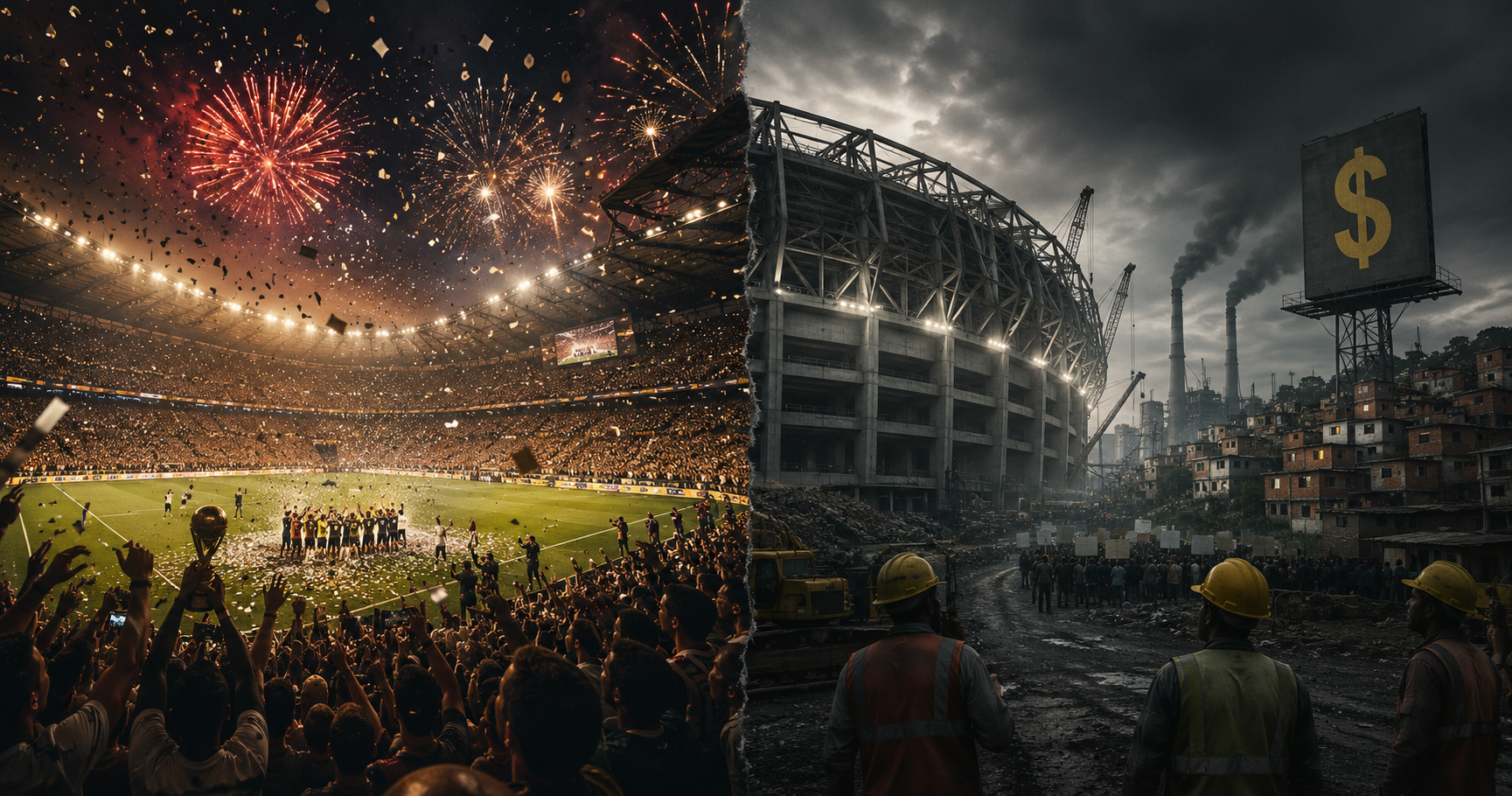
World Cup 2026: The Biggest Tournament Ever — And Its Dark Side
The 2026 World Cup began on June 11, 2026, with Mexico vs Portugal at the Estadio Azteca. It's the first 48-team, 3-nation tournament in history. It's also the most controversial sporting event of the decade.
By the Numbers
| Stat | Value |
|---|---|
| Teams | 48 (up from 32) |
| Host Nations | USA, Mexico, Canada |
| Host Cities | 16 (11 USA, 3 Mexico, 2 Canada) |
| Total Matches | 104 |
| Duration | June 11 — July 19, 2026 |
| Estimated Cost | $11 billion+ |
| Expected Attendance | 5.5 million+ |
| FIFA Revenue Target | $11 billion |
The Format: Bigger ≠ Better?
New Format
48 teams → 12 groups of 4 → top 2 + 8 best 3rd-place teams advance → Round of 32 knockout. That's 104 matches total — 40 more than Qatar 2022.
The expansion from 32 to 48 teams was pushed by FIFA president Gianni Infantino, who claimed it would "democratize" football. Critics say it's pure money-grab — more games = more TV rights = more sponsor revenue. The sporting quality? Debatable. Group stage now includes teams ranked outside the top 100 that wouldn't have qualified under the old format.
Controversy #1: The Human Cost
The 2026 World Cup bid was awarded in 2018, but the human rights questions never went away.
Stadium Construction Deaths
Qatar 2022: 6,500+ migrant worker deaths (official: 40). 2026: No centralized tracking exists across 3 countries with 3 different labor laws. Early estimates suggest hundreds of construction-related injuries across the 16 venues. FIFA's response? "We leave worker safety to local authorities."
Displacement & Gentrification
Atlanta: Mercedes-Benz Stadium area — 300+ families displaced for "infrastructure improvements." Los Angeles: SoFi Stadium parking lot expansion pushed out a low-income housing project. Mexico City: Azteca renovation budget ballooned 3x while surrounding neighborhoods saw zero infrastructure investment.
FIFA's Immunity Claim
In 2025, FIFA successfully argued in Swiss courts that it is not legally responsible for human rights violations in host nations because it is "a sports governing body, not a government." This legal shield means victims have no path to compensation through FIFA directly.
Controversy #2: Environmental Disaster
The 2026 World Cup is projected to be the highest-carbon World Cup in history.
| Factor | Impact |
|---|---|
| 3-nation travel | Teams + fans flying between USA, Mexico, Canada across 16 cities spanning 4 time zones |
| Air conditioning | 9 of 16 stadiums are climate-controlled domes in summer heat |
| Construction | 5 new stadiums built, 11 renovated — concrete is one of the highest-CO2 materials |
| Estimated carbon footprint | 3.6 million tons CO2 — 40% higher than Qatar 2022 |
FIFA's offset program? "We plant trees." Environmental scientists have called the program "greenwashing of the highest order," noting that tree-planting offsets take 20+ years to sequester the carbon emitted in a single month.
Controversy #3: The Money Trail
FIFA Revenue Target
7.5B). Where does it go? FIFA is a "non-profit" organization registered in Switzerland. It pays near-zero tax.
Ticket prices have reached absurd levels:
- Group stage: 800
- Round of 16: 1,200
- Final (MetLife Stadium, July 19): 6,000 (face value)
- Resale market: Final tickets listed at $15,000+
For context: the average monthly salary in Mexico is ~$600. A single group-stage ticket costs more than many locals earn in a month.
Sponsorship deals crossed 200M+ for exclusive beer rights — then discovered 8 of 16 stadiums are in dry counties or have strict alcohol restrictions.
Controversy #4: Sportswashing 2.0
The 2026 World Cup was awarded BEFORE the 2015 FIFA corruption scandal fully unraveled. The US Department of Justice indictment that brought down Sepp Blatter and dozens of FIFA executives didn't stop the tournament — it just changed the faces at the top.
Infantino, who replaced Blatter, has:
- Moved FIFA's headquarters to a tax-free zone in Zurich
- Fought to keep his $2M+ salary secret (it leaked anyway)
- Pushed for a biennial World Cup (every 2 years) — rejected after massive backlash
- Called critics of Qatar's human rights record "hypocrites" and told Europe to "apologize for the next 3,000 years"
The Football: Who's Actually Good?
Amid the chaos, there's still football being played:
Favorites:
- France — Defending champions. Mbappe in his prime. Scary.
- Brazil — Vini Jr. + Rodrygo + Endrick. The attack is unfair.
- Argentina — Messi's last dance (for real this time). Copa America 2024 winners.
- England — Bellingham, Saka, Foden. Most talented squad in decades. Somehow still England.
Dark Horses:
- Morocco — Semifinalists in 2022. African football is rising.
- Japan — Technical, disciplined, finally have a striker (thanks, Celtic).
- USA — Home advantage. Pulisic, Reyna, Balogun. Quarterfinals or bust.
The 48-team effect: Groups now have 3-match guarantees. A team can lose 2 games, win 1 against San Marino, and advance as a 3rd-place qualifier. This dilutes the group-stage drama that made World Cups special.
What's Actually at Stake
The World Cup stopped being "just football" decades ago. The 2026 edition crystallizes everything wrong with modern mega-events:
- Democratic deficit — FIFA operates with near-zero accountability
- Human cost externalized — Workers, displaced families, and local communities pay the price
- Environmental damage ignored — Carbon offset promises that scientists call fraudulent
- Wealth extraction — Revenue flows upward (FIFA, sponsors, broadcasters); costs flow downward (taxpayers, local governments)
And yet — 5.5 million people will attend. Billions will watch. The goals will be beautiful, the drama will be real, and for 90 minutes at a time, none of the above will matter to anyone in the stadium.
That's the uncomfortable truth of the World Cup. We know how the sausage is made. We eat it anyway.
Will I watch? Of course. Will I write about the hypocrisy while wearing a jersey? Absolutely. Welcome to 2026.