The $55K/Year Tech Debt Nobody Noticed — How I SOLD a Massive Refactor to Management (And WON)
Your MVP was built in record time, but now every new feature takes 3X longer? This is the raw, unfiltered true story of how silent tech debt secretly devoured $55,000/year — and the EXACT framework I used to convince management that refactoring is an explosive investment, not a cost.
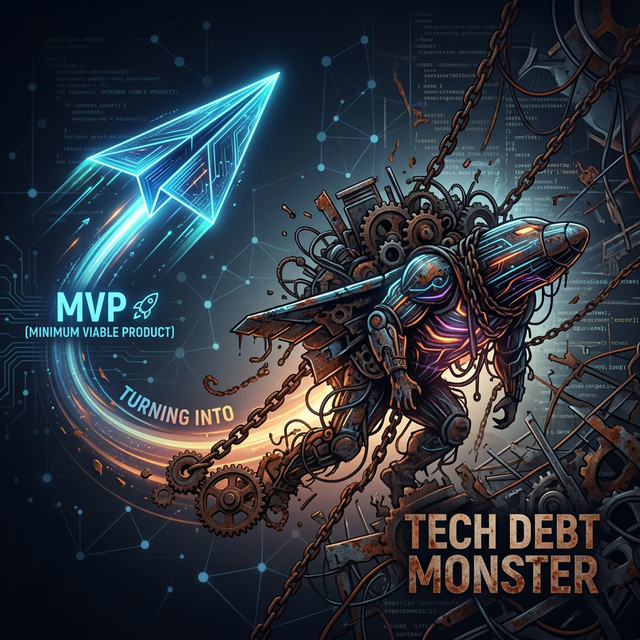
- Refactoring & Compounding Tech Debt
- 1. The Reckoning: When MVP Becomes a Monster
- 1.1 A Familiar Story
- 1.2 Signs that Tech Debt is Compounding
- 2. The Cost of Bad Code: Calculating Business Losses
- 2.1 Where Developer Time Actually Goes
- 2.2 Quantifying the Loss in Currency
- 2.3 The Compound Interest of Tech Debt
- 3. Large-Scale Migration: Zero Downtime Transformation
- 3.1 Anatomy of a Large-Scale Migration
- 3.2 The Strangler Fig Pattern
- 3.3 Reverse Proxy: The Key to Zero Downtime
- 3.4 Lesson: What Went Well and What Didn't
- Design System First
- Feature Flag per Route
- Parallel Comparison Testing
- API Contract via OpenAPI
- Shared State Management
- CSS Specificity Wars
- Underestimated Edge Cases
- 4. Selling the Refactor to Management
- 4.1 Why This Is Hard
- 4.2 Framework: The Refactoring Business Case
- Quantify the Problem (Data, Not Opinions)
- Calculate the Cost of Inaction
- Present the Investment (Not "Cost")
- Show the Timeline with Milestones
- Propose Risk Mitigation
- 4.3 Pitch Deck: The One Convincing Slide
- 5. Playbook: Measurable Refactoring Strategy
- 5.1 Prioritization Matrix
- 5.2 The 20% Rule
- 5.3 Metrics Dashboard: Track the Recovery
- 6. Lessons Learned: What We'd Do Differently
- 7. Conclusion
- Acknowledge That MVP Speed Has a Price
- Quantify the Loss, Don't Complain
- Gradual Migration, Not Big Bang
- Sell it with ROI, Not Ego
- Prevent, Don't Await a Crisis
Refactoring & Compounding Tech Debt
"Move fast and break things. Unless you are breaking things faster than you can fix them." — Adapted from Mark Zuckerberg's later reflection
Context of this Article
This article is not an academic theory about tech debt. This is a real retrospective — the moment a team realized that their initial development speed (MVP) had become a technical debt that choked business iteration. We will dissect the true cost, migration strategy, and how to convince management that pausing to fix the foundation is the smartest business decision they can make.
1. The Reckoning: When MVP Becomes a Monster
1.1 A Familiar Story
Every startup has been at this point. The first month, everything feels magical — features are shipped in days, pivots happen in hours, and "we'll fix it later" becomes the team's mantra.
Then "later" arrives.
1.2 Signs that Tech Debt is Compounding
Deploy Fear
The team is afraid to deploy on Friday — even on Monday they start getting anxious. Every release feels like playing Russian roulette.
Merge Conflict Hell
A simple pull request triggers conflicts in 15 files. Developers spend more time resolving conflicts than writing new code.
Onboarding Nightmare
New engineers need 2-3 months to become productive, not because of domain complexity, but because of an incomprehensible codebase.
Feature Paralysis
A feature that should be finished in 3 days takes 3 weeks because they have to 'work around' a fragile architecture.
The Silent Killer
Tech debt never arrives suddenly. It compounds — like unpaid loan interest. Every sprint spent without paying down the debt increases the interest. And one day, the interest is larger than the team's capacity to pay.
2. The Cost of Bad Code: Calculating Business Losses
2.1 Where Developer Time Actually Goes
One of the most awakening moments was when we conducted a time audit for 4 consecutive sprints and found this data:
A Shocking Data Point
Developers spent 70% of their time just resolving code conflicts, fixing regressions, and navigating a fragile architecture — instead of building features. This means out of 5 engineers, only 1.5 engineers were truly productive in building new value.
2.2 Quantifying the Loss in Currency
Let's quantify this real loss so we can speak in an language that management understands. (Using IDR conversions originally, translated contextually).
const healthyTeam = {
  engineers: 5,
  monthlyRate: 30_000_000, // per engineer, fully loaded
  totalMonthlyCost: 5 * 30_000_000, // = Rp 150,000,000

  timeDistribution: {
    featureDevelopment: 0.55, // 55%
    bugFix: 0.1, // 10%
    codeReview: 0.1, // 10%
    techDebt: 0.1, // 10% (proactive)
    meetings: 0.1, // 10%
    mergeConflicts: 0.05, // 5%
  },

  effectiveFeatureOutput: 5 * 0.55, // = 2.75 engineer equivalents
  monthlyFeatureValue: 2.75 * 30_000_000, // = Rp 82,500,000 worth of features
  velocityTrend: "accelerating",
};const troubledTeam = {
engineers: 5,
monthlyRate: 30_000_000,
totalMonthlyCost: 5 * 30_000_000, // = Rp 150,000,000 (same!)
timeDistribution: {
featureDevelopment: 0.15, // 15% — tragic
bugFix: 0.2, // 20%
codeReview: 0.1, // 10%
mergeConflicts: 0.25, // 25% — primary killer
workarounds: 0.15, // 15%
debugging: 0.1, // 10%
waiting: 0.05, // 5%
},
effectiveFeatureOutput: 5 * 0.15, // = 0.75 engineer equivalents
monthlyFeatureValue: 0.75 * 30_000_000, // = Rp 22,500,000 worth of features
velocityTrend: "decelerating",
};| Metric | Healthy Team | Troubled Team | Delta |
|---|---|---|---|
| Monthly Cost | Rp 150 Million | Rp 150 Million | Same |
| Time on Features | 55% | 15% | -40pp |
| Effective Output | 2.75 engineers | 0.75 engineers | 3.67x lower |
| Value per Month | Rp 82.5 Million | Rp 22.5 Million | Rp 60 Million wasted |
| Value per Year | Rp 990 Million | Rp 270 Million | Rp 720 Million wasted |
| Velocity Trend | Up | Down | Diverging |
The Real Cost
With an identical team cost (Rp 150 Million/month), the team with a troubled codebase loses Rp 720 Million per year in the form of wasted engineer time. This is equivalent to throwing away 2.4 engineers every month. And this number does not even include the opportunity cost of unshipped features, lost customers, and declining team morale.
2.3 The Compound Interest of Tech Debt
Notice the graph above. Both teams start at the same point (40 story points per sprint). The team that does not invest in refactoring experiences a continuous velocity decline — from 40 to 10 in 8 quarters.
The team that allocates 20% of their sprints for tech debt does experience a slight dip initially (due to reduced bandwidth), but then their velocity explodes as the codebase becomes cleaner and easier to extend.
The Math
After 2 years, the team investing in refactoring produces 6.5x more output than the team ignoring tech debt — even though they "only" spend 80% of their time on features.
3. Large-Scale Migration: Zero Downtime Transformation
3.1 Anatomy of a Large-Scale Migration
The following retrospective is from a real project: migrating a legacy frontend to a modern architecture without disrupting active customers.
Prop
Type
3.2 The Strangler Fig Pattern
The strategy we used: Strangler Fig Pattern — gradually replacing legacy components with new components, without ever performing a "big bang" switch.
3.3 Reverse Proxy: The Key to Zero Downtime
The most critical concept: using a reverse proxy (Nginx/Caddy/Traefik) to route traffic between the legacy and new apps based on paths or feature flags.
# Phase 2: Route-based migration
# Migrated pages → New App
# Unmigrated pages → Legacy App

upstream legacy_app {
    server 127.0.0.1:3000;
}

upstream new_app {
    server 127.0.0.1:4000;
}

server {
    listen 80;
    server_name app.example.com;

    # Pages migrated to new app
    location /dashboard {
        proxy_pass http://new_app;
    }

    location /settings {
        proxy_pass http://new_app;
    }

    location /reports {
        proxy_pass http://new_app;
    }

    # All other pages remain on legacy
    location / {
        proxy_pass http://legacy_app;
    }
}
Gradual Rollout
With this approach, you can migrate one page per sprint, validate with real users, and rollback in seconds if an issue arises — simply by modifying the proxy config. Zero downtime, zero drama.
3.4 Lesson: What Went Well and What Didn't
Design System First
Building the component library and design system before starting the migration ensured UI consistency and exponentially accelerated the development of subsequent pages.
Feature Flag per Route
Using feature flags allowed for phased rollouts (1% → 10% → 50% → 100%) and instant rollbacks. Not a single incident of downtime occurred during the migration.
Parallel Comparison Testing
Running both versions in parallel and comparing output helped catch behavioral discrepancies prior to full rollout.
API Contract via OpenAPI
Defining API contracts before migrating ensured backend and frontend could evolve independently.
Shared State Management
Session and authentication states between legacy and the new app were the biggest source of bugs. Cookie conflicts, token expiry mismatches, and CORS issues cost an extra 3 weeks.
CSS Specificity Wars
Legacy global CSS collided with CSS Modules in the new app. Several pages suffered from "style bleeding" that was hard to debug.
Underestimated Edge Cases
"Simple" looking pages turned out to hold dozens of edge cases only discovered in production — form validation rules, conditional rendering based on user roles, and third-party integrations.
| Lesson | Detail |
|---|---|
| Isolate CSS from day one | Use CSS Modules, CSS-in-JS, or Tailwind — never let global CSS leak across systems |
| Define auth boundaries | Session management must be solved before migrating the first page, not on the fly |
| Start migration with the simplest page | Not the most important page. Build team muscle memory with low-risk pages first |
| Budget 30% buffer | Every migration estimate must add 30% for unforeseen edge cases |
| Don't freeze new features | Business won't wait. Build new features in the new app, keep legacy maintenance minimal |
4. Selling the Refactor to Management
4.1 Why This Is Hard
The Communication Gap
When engineers say "we need a refactoring", management hears "we want to play around with code without producing anything visible to customers." This communication gap is the root of the problem. The solution isn't avoiding the conversation — it's changing the language.
4.2 Framework: The Refactoring Business Case
Never approach management with "we need to refactor because the code is bad." Come with a structured business case.
Quantify the Problem (Data, Not Opinions)
Gather data over 2-4 sprints:
const currentState = {
  // Velocity metrics
  avgVelocity: {
    sixMonthsAgo: 42, // story points per sprint
    current: 18, // story points per sprint
    trend: "declining",
    projectedIn6Months: 8,
  },

  // Time distribution
  timeOnFeatures: 0.15, // 15% — should be 50%+
  timeOnBugFixes: 0.25, // 25% — should be <15%
  timeOnMergeConflicts: 0.2, // 20% — should be <5%

  // Business impact
  avgFeatureDeliveryTime: {
    sixMonthsAgo: "5 days",
    current: "18 days",
  },

  // Incident frequency
  productionIncidents: {
    sixMonthsAgo: "1 per month",
    current: "4 per month",
  },

  // Team health
  developerSatisfaction: 3.2, // out of 10
  attritionRisk: "HIGH",
};
Calculate the Cost of Inaction
const costOfInaction = {
  // Wasted engineer time per month
  wastedTimePerMonth: {
    engineers: 5,
    wastedPercentage: 0.55, // 55% time wasted
    monthlyCost: 5 * 30_000_000 * 0.55,
    // = Rp 82,500,000 per month wasted
  },

  // Projected over 12 months
  annualWaste: 82_500_000 * 12,
  // = Rp 990,000,000 (Almost 1 Billion Rupiah!)

  // Attrition cost if developers resign
  attritionCost: {
    probabilityOfResignation: 0.4, // 40% risk
    costPerReplacement: 150_000_000, // 5x monthly salary
    expectedAttritionCost: 0.4 * 2 * 150_000_000,
    // = Rp 120,000,000 (2 engineers likely to leave)
  },

  // Opportunity cost: unshipped features
  lostRevenue: {
    featuresDelayed: 8, // per quarter
    avgRevenuePerFeature: 50_000_000,
    quarterlyLoss: 8 * 50_000_000,
    // = Rp 400,000,000 per quarter
  },

  totalAnnualCost: 990_000_000 + 120_000_000 + 400_000_000 * 4,
  // = Rp 2,710,000,000 (Rp 2.71 Billion!)
};
Present the Investment (Not "Cost")
const refactoringInvestment = {
  duration: "8 weeks focused refactoring",
  teamAllocation: "3 of 5 engineers (2 remain on features)",
  investmentCost: 3 * 30_000_000 * 2, // 3 eng x 2 months
  // = Rp 180,000,000

  expectedOutcomes: {
    velocityRecovery: "18 → 35 story points (+94%)",
    featureDeliveryTime: "18 days → 7 days (-61%)",
    bugRate: "-60% production incidents",
    mergeConflicts: "-80% conflict resolution time",
    developerSatisfaction: "3.2 → 7.5 (out of 10)",
  },

  roi: {
    annualSavings: 990_000_000 * 0.6, // 60% waste recovered
    // = Rp 594,000,000 per year
    investmentCost: 180_000_000,
    roiMultiple: 594_000_000 / 180_000_000,
    // = 3.3x ROI in year 1
    paybackPeriod: "~4 months",
  },
};
Show the Timeline with Milestones
Propose Risk Mitigation
2 Engineers Remain on Features
The business does not halt. 2 out of 5 engineers remain focused on high-priority features during the refactoring period, ensuring the product pipeline doesn't dry up.
Rollback Plan
Every refactoring change is made in a separate branch with feature flags. Should issues arise, rollbacks can happen in minutes, not hours.
Weekly Progress Report
Every week, management receives a report: what was fixed, which metrics changed, and an ETA for completion. Full transparency, no surprises.
Kill Switch
If after 4 weeks there is no measurable improvement, the team returns to 100% feature mode. Management has total control.
4.3 Pitch Deck: The One Convincing Slide
If you only have one slide to convince management, use this:
| Without Refactoring | With Refactoring | |
|---|---|---|
| Investment | Rp 0 | Rp 180 Million (8 weeks) |
| Annual Loss | Rp 2.71 Billion | Rp 990 Million |
| Feature Delivery | 18 days/feature (worsening) | 7 days/feature (improving) |
| Production Incidents | 4x/month (rising) | 1x/month (stable) |
| Developer Attrition Risk | 40% (2 people) | 10% (normal) |
| Velocity Trend | Down 50% per 6 months | Up 20% per quarter |
| Net Impact (Year 1) | -Rp 2.71 Billion | +Rp 594 Million saving |
| ROI | N/A | 3.3x |
Pitch Closing Statement
"Pausing feature releases for 8 weeks to fix the foundation is not stalling the business — it's saving Rp 1.72 Billion per year and restoring the team's ability to move fast. Without this investment, in 12 months we will require a total rewrite costing 5-10x more."
5. Playbook: Measurable Refactoring Strategy
5.1 Prioritization Matrix
Not all tech debt is equal. Use this matrix to prioritize:
5.2 The 20% Rule
Sustainable Debt Management
Once a major refactoring is complete, allocate 20% of every sprint to tech debt prevention. This is like paying mortgage installments — small, consistent, and preventing the debt from piling up again. 20% today prevents a 100% rewrite tomorrow.
interface SprintAllocation {
  featureDevelopment: number;
  techDebtPaydown: number;
  bugFixes: number;
}

const sustainableAllocation: SprintAllocation = {
  featureDevelopment: 70, // New features for business
  techDebtPaydown: 20, // Pay down tech debt installments
  bugFixes: 10, // Buffer for unforeseen bugs
};

// Monitor: If bugFixes consistently > 20%,
// it's a sign tech debt is still too high
5.3 Metrics Dashboard: Track the Recovery
After refactoring begins, track these metrics every sprint:
Prop
Type
6. Lessons Learned: What We'd Do Differently
7. Conclusion
TL;DR
Tech debt is not a technical problem — it's a business problem that happens to manifest in code. The way to overcome it is not with technical jargon, but with business language: measurable losses, quantifiable investments, and accountable ROI.
Acknowledge That MVP Speed Has a Price
Every past shortcut is a loan that now must be repaid. It wasn't a mistake — it was the correct decision at the time. But now contexts have changed, and the debt must be managed.
Quantify the Loss, Don't Complain
Don't say "the code is messy." Say: "The team loses Rp 720 Million manually per year because 70% of time gets wasted navigating fragile architectures." Data beats opinions.
Gradual Migration, Not Big Bang
Strangler Fig Pattern. Feature flags. Reverse proxies. Zero downtime. There is absolutely no reason to risk a running business just to refactor.
Sell it with ROI, Not Ego
Management doesn't care that your code is "cleaner." They care that a Rp 180 Million investment generates Rp 594 Million in annual savings. Frame it as an investment, not an expense.
Prevent, Don't Await a Crisis
Allocate 20% of every sprint for tech debt. Pay the installment. Don't wait until the interest eclipses the principle.
"The best time to refactor was 6 months ago. The second best time is now." Every passing day absent of action compounds the tech debt interest. Start today — not with a massive rewrite, but with one measured step proving that fixing the foundation is a powerful investment, not a cost.